
deciBels (dB)
deciBels (dB for short) are a convenient way to look at oscillating signals on a logarithmic scale. The official definition is: dB = 10log10(x/xref)2. We square the argument since dB is based on the intensity or power of a signal. In acoustics, x is pressure (usually rms over a given time period) and the approximate lower limit of human hearing (20 μPa) is the reference. We use the notations of Sound Pressure Level (SPL) or Lp, so: SPL = Lp = 10log10(p/20 μPa)2.
dB Math
If two sound sources are combined, for example a motor and an air compressor, the total sound is of course louder.
To compute the dB level of summed signals you have to 'un-dB' them first. You cannot add or subtract dB values!
The sum of two signals is: Lpsum = 10log10(10(Lp1/10) + 10(Lp2/10))
This is effectively taking the square root of the sum of the squares (SRSS) and converting the result to dB.
Important: this assumes the two sources are incoherent. Coherent signals, such as the sound from a motor combined with its reflection from a nearby wall, sum differently (a topic for another demonstrator someday).
Here's a plot and handy table of how the dB levels from two incoherent sources sum.
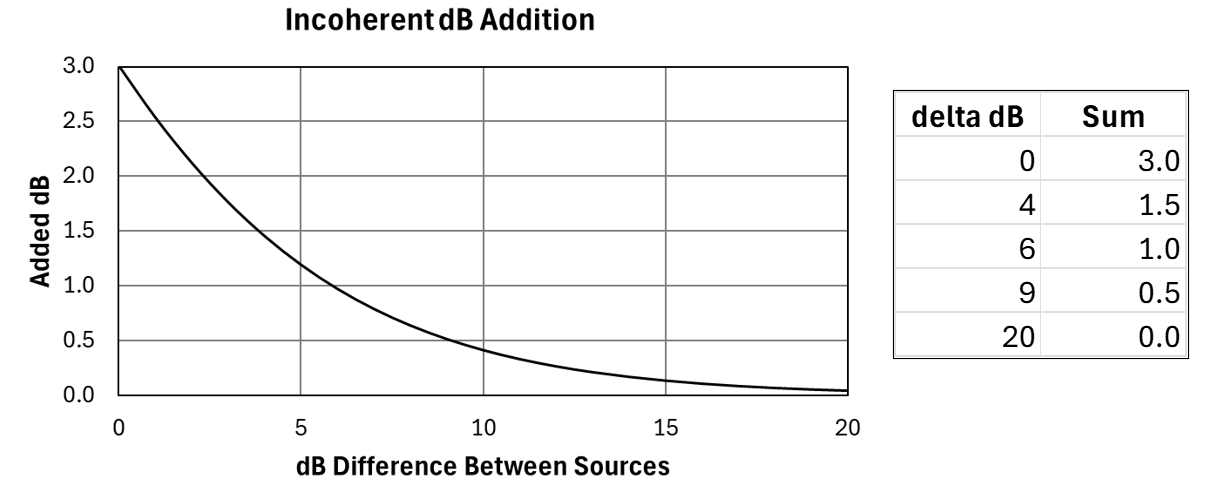
The same principles apply to background noise corrections. If you are trying to measure the dB level of a source but another background noise source is present you can use the same approach: Lp1 = 10log10(10(Lptot/10) - 10(Lp2/10)). This approach is only valid, however, if the background noise levels are comparable to or less than the source level. Of course, you would need to measure your background noise levels first (always a good measurement protocol).
Demonstrator
This demonstrator adds the sound pressure levels of two incoherent sounds. Simply adjust the dB level of either signal and observe the effect on the summed signal on the right. You can also compare the summed dB level to an allowable limit, like the 85 dB exposure limit specified by OSHA and many other countries. The limit is shown as a black line on the guage and the difference is shown below the summed level. Adjust the dB limit with the right slider.
|
dB |